


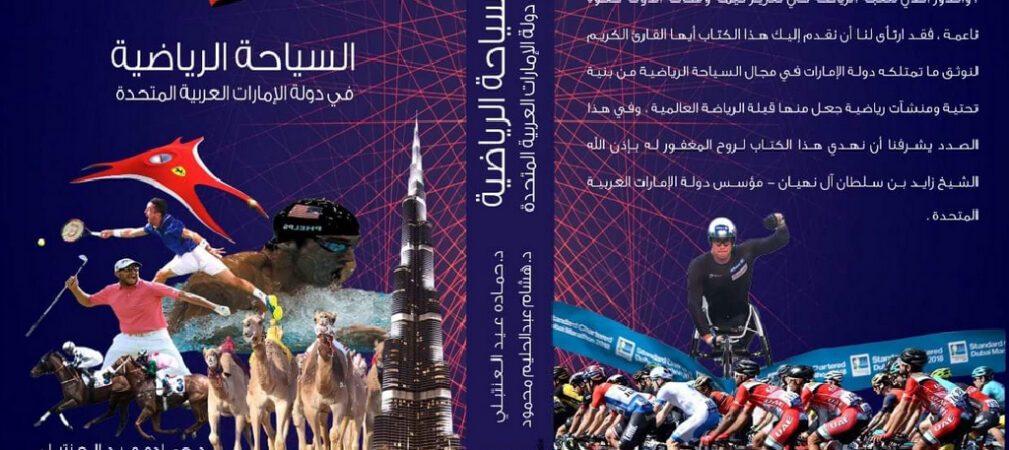
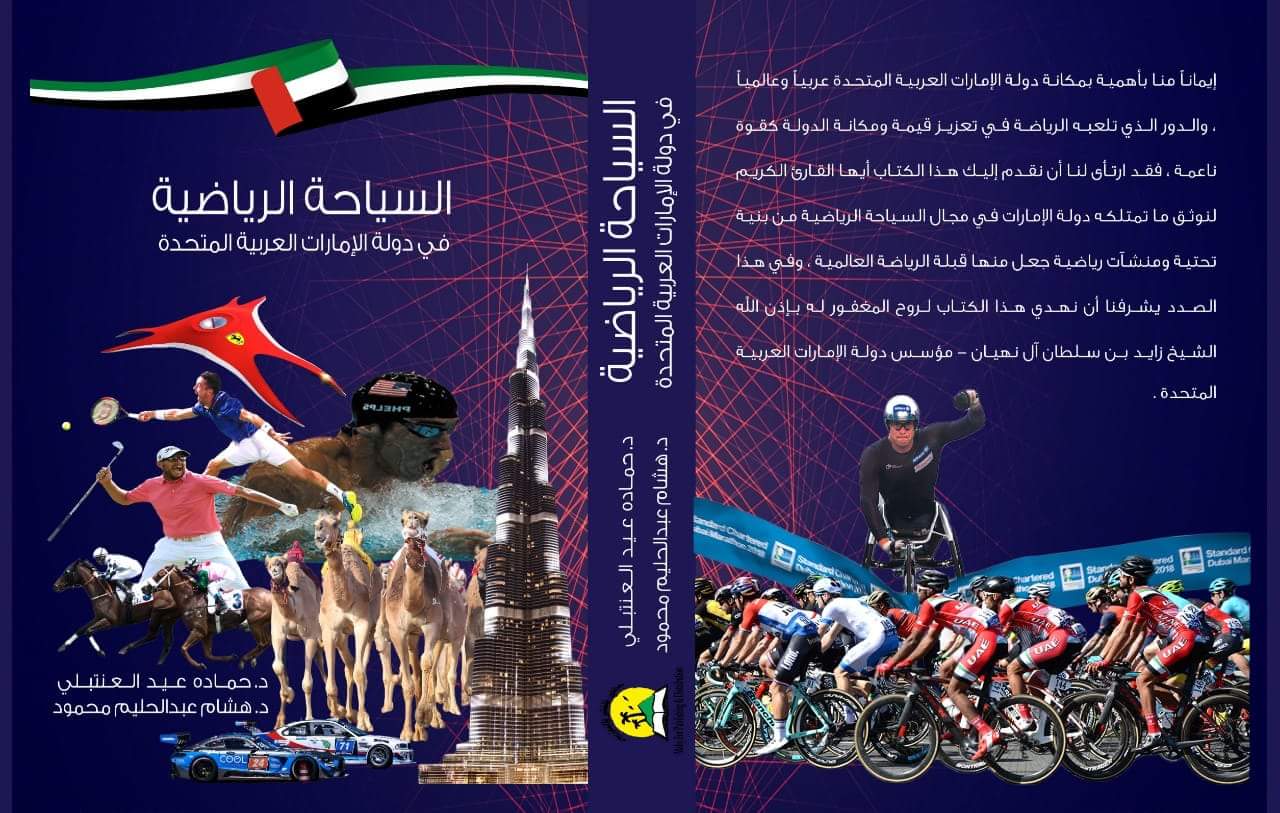
I wrote Sports Tourism in the United Arab Emirates because sport and tourism—when they meet in the right way—do not simply create “events”; they create economic value, cultural dialogue, and a living image of a nation. This book was my attempt, with my colleague Dr. Hisham Abdel Halim Mahmoud, to offer a comprehensive reference that explains why the UAE has become one of the most suitable destinations for sports tourism, and how each of its seven emirates contributes a distinct “sporting experience” to the whole.
Tourism is one of the most important economic sectors affecting many countries directly—especially those with strong attractions—and the UAE is clearly among them because of its natural and human capabilities. At the same time, sport has become a major element in the culture of societies, and an intense attraction—cultural, political, and touristic—rather than a simple recreational activity. I have always found that intersection fascinating: when sport grows beyond stadiums and becomes a language through which a country is visited, experienced, and remembered.
Over time, I also noticed a global shift: tourism and sport increasingly serve each other, as many people prefer to spend vacations practicing sports or watching sports activities in destinations they consider advanced. This shift produced what the book describes as “active tourism,” where movement, experience, and participation become central to travel rather than passive sightseeing alone. And importantly, sports tourism is not limited to the tourist practicing the activity; it also includes attending and enjoying sports occasions and global festivals as a spectator.
This is where my motivation became very clear: the UAE is already doing a great deal in this domain, yet many readers—students, researchers, administrators, and even sports fans—did not have one consolidated Arabic academic reference that gathers the topic, explains the components, and documents the details across all seven emirates. That gap was the real beginning of the writing journey.
The UAE has deliberately sought to provide the requirements for practicing and watching many sports—stadiums, world-class sports facilities, accommodation, and supporting services—across its seven emirates. Each emirate has its own character, and this identity appears in the facilities it builds, the events it hosts, and the type of enjoyment it offers to the tourist who searches for a particular experience. The book uses an image I personally like: the emirates together form “a necklace of pearls,” making the UAE among the countries most suitable for sports tourism globally.
That is not merely poetic language. It reflects a strategic reality: diversity is one of the strongest advantages in sports tourism. A destination that can offer desert endurance, marine sports, world-class golf, heritage competitions, modern arenas, and family-oriented tourism in one national space has a competitive advantage that many countries spend decades trying to build.
So the purpose of the book was not to “praise” the UAE as an idea, but to study it as a working model—what resources it has, how they connect, what makes them attractive, and how this sector can be understood and developed academically and practically.
In the introduction, we explain that we wanted to provide the reader with what satisfies their need when discussing sports tourism in the UAE, and to offer a reference showing the country’s natural and human components, facilities, and hosted events across the seven emirates—supporting the idea of the UAE as a “capital of sport” in the Arab world and the wider Middle East.
For that reason, the book is organized into ten integrated chapters. The structure is deliberately comprehensive, because sports tourism is not one topic; it is a system that includes geography, infrastructure, heritage, institutions, events, and the visitor experience.
The chapters move as follows:
Chapter 1: Natural and human components of sports tourism in the UAE.
This chapter highlights geography, climate, transport networks, infrastructure, and tourism facilities. It also stresses that a strong tourism environment loses value if it is difficult to reach, and that transport, accommodation, and services are essential pillars of the sports tourism industry.
Chapter 2: Sports in Emirati folk heritage.
We present sports deeply rooted in Emirati heritage that ancestors practiced and that are still preserved and passed down today. This heritage element is not a “museum”; it is a living product that can be presented responsibly to visitors.
Chapter 3: An overview of sports tourism in the UAE.
This chapter discusses the country’s location, its seven emirates, sports associated with them, examples of hosted events, and also introduces sports councils and sports awards launched in the UAE.
Chapters 4–10: Sports tourism in each emirate.
We dedicate one chapter to each emirate—Abu Dhabi, Dubai, Sharjah, Ajman, Ras Al Khaimah, Umm Al Quwain, and Fujairah—covering the attractions, facilities, and sports events that define each destination. This design reflects the idea that each emirate offers its own “tourism personality,” while still belonging to one integrated national model.
Writing a 618-page first edition was not simply a matter of collecting information; it was an exercise in respect—respect for the field, for the reader, and for the country being studied. Sports tourism intersects with economics, management, geography, culture, infrastructure planning, and event organization. That complexity can easily produce a fragmented book. My challenge was to make it coherent.
I also wanted the book to speak to more than one type of reader:
The academic who needs clear structure, definitions, and documented scope.
The practitioner who works in tourism, sport, or event organization and needs a practical map of opportunities.
The student who wants a strong foundation for future research.
The sports lover who wants to understand why certain destinations succeed and how the system works.
The dedication in the book reflects this wide audience: it is addressed to the rulers and leaders of the UAE, to every lover of sports tourism, to every lover of the UAE, to our families, to colleagues and professors inside and outside the sports field, and to students and researchers. That dedication expresses something personal: knowledge is never produced in isolation. It grows from communities, mentors, and lived experience.
Sports tourism is not only a tourism topic; it is an industry that requires coordination and professional planning. That is why I see the book as useful for several groups:
Tourism professionals and destination planners: because the book maps the UAE’s attraction components—natural and human—and connects them to infrastructure and services.
Sports administrators and event organizers: because it documents the relationship between hosting, facilities, and the visitor experience across emirates.
Researchers and postgraduate students: because it offers a structured, ten-chapter framework and detailed subtopics that can support studies in sports economics, event legacy, and destination branding.
Investors and sponsors: because sports tourism thrives when facilities, transport, accommodation, and events are integrated into a coherent economic product.
Athletes and fans (as travelers): because sports tourism includes both participation and spectatorship, and the UAE offers both at scale.
The introduction states that the UAE provides sports facilities and global-quality venues across its seven emirates, and that this diversity contributes to its leading position in sports tourism. The book’s intended impact is to help readers see sports tourism not as accidental success, but as an outcome of planning: geographic advantage, infrastructure development, event hosting strategy, and cultural heritage preservation—all interacting in one system.
At a wider level, I hoped this book would contribute to the Arab sports library by treating sports tourism as a serious academic and professional discipline, not as a marginal topic. When a field is documented well, it becomes teachable. And when it becomes teachable, it becomes developable.
At the end of the introduction, we addressed the reader directly: regardless of whether the reader’s position is administrative, touristic, or athletic, this is a modest effort—and feedback is welcome—because the goal is to improve sports tourism and enrich how athletes and researchers see it. I also repeat the principle we included: mastery matters, and every serious field deserves serious work.
This book was written with a simple hope: that sports tourism in our region will be understood as a strategic opportunity—one that builds economies, opens cultures to each other, and gives sport a new way to serve society beyond competition.
