


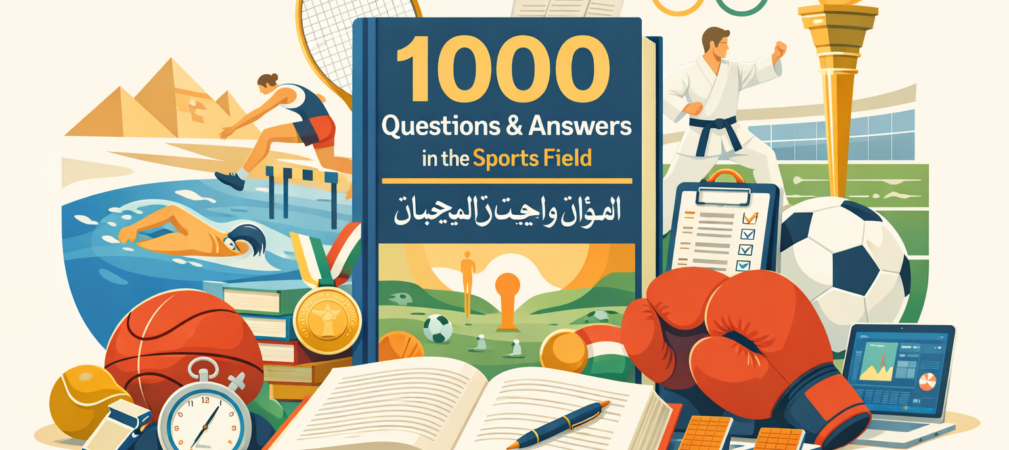
When I first embarked on writing “1000 Questions and Answers in the Sports Field,” I never imagined how profoundly this endeavor would transform both my understanding of sports science and my connection with the broader athletic community. What began as a simple desire to compile scattered information evolved into a comprehensive reference work that has since touched the lives of countless students, coaches, athletes, and sports enthusiasts across the Arab world.
Through my years of reading sports literature across various disciplines and different athletic domains, I encountered numerous valuable insights and beneficial information scattered across countless resources. These readings ignited within me a powerful desire to gather, organize, and present this knowledge in an engaging style that would captivate readers. This book became the manifestation of that vision—a labor of love born from the conviction that accessible sports knowledge could transform how people engage with athletics.
The format I chose—a question-and-answer structure—was deliberate and rooted in pedagogical wisdom. My extensive experience in sports research and academic lecturing convinced me that presenting sports information in this accessible format facilitates comprehension and enables readers to acquire maximum knowledge efficiently. Each question is followed immediately by its answer, respecting the reader’s time and effort while eliminating the frustration of flipping through pages searching for responses.
It has been a great honor to compile selected excerpts from the opinions and writings of scholars in the sports field, ensuring the reliability of their sources. Throughout my selection process, I endeavored to exercise utmost precision and verify the accuracy of every piece of sports information presented to readers. This commitment to academic rigor was non-negotiable—I wanted to ensure that this book would serve as a trusted reference, spreading sports culture that would be, God willing, at the forefront of every sports reader’s interests.
I approached this project with humility, recognizing that I was standing on the shoulders of giants who had devoted their careers to advancing sports science. My role was not to create knowledge from nothing, but rather to curate, organize, and present it in a format that would maximize its utility and accessibility. This curatorial responsibility weighed heavily on me throughout the writing process, driving me to verify every fact and cross-reference every claim.
The book’s structure reflects the breadth and depth of the sports world, spanning nine comprehensive chapters that cover virtually every major athletic discipline. In Chapter One, I address general questions, gently guiding readers toward the sports field beginning with the Olympic Games and traversing various sports and games, including a critical examination of doping in sports. This foundational chapter sets the stage for the specialized content that follows, providing context that enriches understanding of subsequent chapters.
Chapter Two explores aquatic sports in all their diversity—swimming in its various forms, diving, rowing, rescue operations, sailing, yachts, and boats. The water has always fascinated me as a medium for athletic expression, and I took particular care to capture the unique challenges and techniques that define aquatic competition. The third chapter examines athletics, rightfully called the “mother of all games” and the “queen of Olympic sports,” where I compiled extensive information about track and field events in both stadium and track disciplines.
The fourth chapter delves into racket sports, including table tennis, tennis, hockey, badminton, and racquetball. These disciplines share common elements yet express themselves in wonderfully distinct ways. Chapter Five focuses on volleyball, covering its origins, history, regulations, skills, and beach volleyball. Basketball receives thorough treatment in Chapter Six, examining its history, championships, rules, and fundamental skills.
Football, the world’s most popular sport, occupies Chapter Seven with comprehensive coverage of its Olympic and international history, information about various teams, regulations, skills, beach soccer, and futsal. Chapter Eight addresses handball in its various forms, including beach handball, while Chapter Nine explores combat sports and self-defense disciplines including karate, taekwondo, wrestling, judo, and boxing, attempting to establish the foundations of each discipline.
Since publication, the feedback has been overwhelming and humbling. Physical education students and faculty members have embraced the book as a supplementary textbook that complements traditional curricula. The question-and-answer format has proven particularly valuable for exam preparation and quick reference during academic discussions. I receive messages from students who tell me they keep the book on their desks during study sessions, treating it as a trusted companion through their educational journey.
Coaches across various sports disciplines have reported using the book as a training resource, helping them articulate fundamental concepts to athletes in clear, accessible language. Several coaches have shared that the comprehensive coverage allows them to broaden their knowledge beyond their specific sport, fostering a more holistic understanding of athletic performance. This cross-pollination of knowledge across disciplines was precisely what I hoped to facilitate.
Sports journalists and media professionals have found the book invaluable for fact-checking and enriching their coverage with accurate historical and technical information. In an era where sports media proliferates across digital platforms, having a reliable Arabic-language reference has filled a critical gap. I’ve seen my work cited in articles, heard it referenced in broadcasts, and watched it contribute to more informed sports discourse in our region.
Perhaps most gratifying has been the feedback from general sports enthusiasts who have discovered newfound appreciation for sports they previously knew little about. The accessible format invites casual reading while maintaining academic credibility—a balance I strived to achieve throughout the writing process. Parents have told me they use the book to answer their children’s questions about sports, turning dinner table conversations into learning opportunities.
Writing this book tested my endurance and deepened my appreciation for the scholars whose work I synthesized. There were moments of frustration when sources contradicted each other, requiring extensive cross-referencing to verify facts. I spent countless hours in libraries, poring over documents, reaching out to experts, and sometimes having to make difficult decisions about which sources to trust when consensus proved elusive.
There were also moments of pure joy when disparate pieces of information suddenly connected, revealing patterns and insights I hadn’t anticipated. These breakthrough moments—often occurring at unexpected times—reminded me why I fell in love with sports science in the first place. The beauty of athletics lies not just in physical achievement but in the intricate systems of knowledge, history, and culture that surround each discipline.
My academic background in sports science and my practical experience conducting numerous research projects in the sports field provided the foundation for this work. However, it was my time spent in lecture halls, observing how students absorbed and questioned information, that truly shaped my approach. I witnessed firsthand how the availability of sports information in question-and-answer format greatly facilitates its reception and subsequent acquisition of knowledge. This observation became the cornerstone of my methodological approach.
As I reflect on this work, I acknowledge its limitations and imperfections. At the conclusion of the book, I sincerely ask God Almighty that we have succeeded in this presentation, and I pray that He forgives us for every mistake, oversight, or omission. No single volume can capture the entirety of sports knowledge, and I recognize that some readers may desire greater depth in specific areas or coverage of disciplines not included.
Yet I take comfort in knowing that this book serves its intended purpose: to make sports knowledge more accessible, to inspire curiosity about athletic disciplines, and to provide a reliable starting point for deeper exploration. If this work encourages even one student to pursue sports science more seriously, or helps one coach better serve their athletes, or enables one journalist to report more accurately, then the countless hours invested will have been worthwhile.
The sports industry continues to evolve, with new research constantly expanding our understanding of human performance, biomechanics, psychology, and nutrition. I hope this book serves as a foundation upon which readers can build their knowledge, always remaining curious and committed to learning. The question-and-answer format I chose reflects my belief that learning begins with inquiry—that every answer should spark new questions, propelling us forward on an endless journey of discovery.
To those who have read, studied, and shared this book: thank you. Your engagement validates the vision that drove me to write it. To students preparing for exams, to coaches seeking to improve their craft, to journalists striving for accuracy, and to sports lovers simply pursuing their passion—this book was written for you.
Sports unite us across cultures, languages, and backgrounds. They teach us about discipline, perseverance, teamwork, and the pursuit of excellence. In documenting the knowledge that underpins athletic achievement, I hope to contribute, however modestly, to the rich tradition of sports scholarship in the Arab world. May this work serve as a bridge between theoretical knowledge and practical application, between academic understanding and lived experience on the playing field.
God is the source of all success, and to Him we return.
