



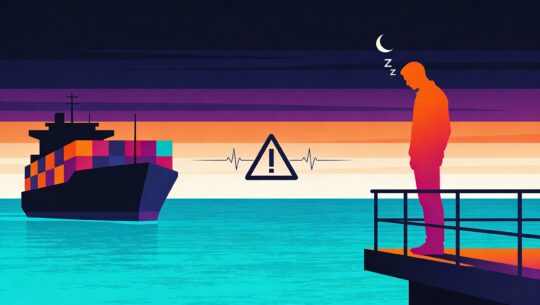
When people think about maritime transport, they usually picture ships, cargo, ports, and global trade routes. But behind every safe voyage there is a human being—often working long shifts, living under pressure, and trying to stay alert in an environment where one mistake can cost lives, money, and the environment. I wrote this scientific paper because I became convinced that one of the most underestimated risks in maritime work is not mechanical failure; it is human fatigue driven by sleep disorders and disrupted sleep patterns—and how that fatigue quietly damages both health and physical readiness.
This article is written in my own voice for my personal blog, because this work was not only academic to me. It felt like a responsibility. Sleep is basic, yet in many demanding professions it becomes negotiable. At sea, sleep is often fragmented, irregular, and vulnerable to operational demands. The paper explores the impact of sleep disorders on health and physical fitness, and it considers solutions that can protect people working in maritime transport—because safety culture begins with human wellbeing.
Sleep is not simply “rest.” Sleep is a biological repair process that supports immunity, hormonal balance, metabolic regulation, cognitive performance, and emotional stability. When sleep is chronically disrupted, the consequences appear across the body and mind: reduced attention, slower reaction time, impaired decision-making, and growing health risks.
The paper is grounded in the “human element” perspective in shipping and refers to multiple maritime safety and human-factor sources, including IMO-related materials and “human element” guidance (such as IMO resolutions and shipping industry references). This framing matters because maritime accidents are rarely caused by one factor. They often emerge from a chain of weaknesses—fatigue and poor sleep are among the most persistent and dangerous links in that chain.
The references within the paper also point to fatigue research in the shipping industry and discuss the human element as a major component in maritime safety outcomes. For me, that reinforces the central message: protecting sleep is not “personal comfort.” It is operational risk management.
This study required me to step outside the boundaries of traditional sports management research and enter a wider health-and-performance space. In sport science, fatigue is studied intensely. In shipping, fatigue is discussed, but often not with the same depth or urgency—despite the fact that maritime workers must maintain sustained alertness in a complex environment.
As I developed the work, I reviewed medical and physiological research related to sleep deprivation, sleep disorders, and health outcomes—alongside maritime industry publications on human behavior and safety. The paper references medical sources and sleep-related health links (including web-based sleep-health resources cited in the reference list), reflecting the multidisciplinary nature of the topic. It also draws from shipping-specific sources such as the Maritime and Coastguard Agency’s focus on the human element in the shipping industry, emphasizing how human behavior and fatigue influence operational safety.
A personal challenge in writing this paper was translating medical knowledge into an applied framework that maritime stakeholders can actually use. It is easy to list “sleep is important.” It is harder to connect sleep disruption to specific risks, and then propose practical interventions that fit the realities of ship schedules, watch systems, and operational constraints.
Even from the structure of the document and its reference landscape, the paper’s major themes are clear:
Sleep disruption is linked to fatigue, and fatigue is a serious safety threat in maritime work.
The “human element” is repeatedly emphasized in maritime safety discussions, including the idea that blaming equipment alone is not enough; human behavior and conditions must be addressed.
The work connects sleep issues to wider health concerns (including physiological effects such as metabolic and cardiovascular strain, as reflected by the cited sleep-health sources and medical references).
The paper also touches on measurement and clinical concepts related to sleep (e.g., EEG is referenced in the text), reflecting that sleep can be studied scientifically and not treated as a vague complaint.
The document’s references include fatigue and human factors in shipping, highlighting that maritime industries already recognize fatigue—but need stronger systems to manage it.
For me, the key insight is this: a fatigued worker is not only at higher risk of error. Over time, a fatigued worker becomes less healthy, less resilient, and less capable of maintaining physical fitness, which then compounds operational risk.
This work is aimed at multiple audiences because sleep in maritime transport is not solely a personal issue—it is an institutional and industry issue.
Maritime transport workers (seafarers and crew): because the first beneficiaries of better sleep systems are the people whose bodies and minds carry the burden of long operational cycles.
Shipping companies and operators: because fatigue management improves safety performance, reduces incidents, and protects operational continuity.
Regulators and safety bodies: because policies, standards, and inspections must translate “human element” principles into enforceable practice.
Training institutions: because awareness of sleep science and fatigue risk must become part of professional preparation, not optional information.
Families and communities: because long-term health consequences of sleep disorders extend beyond the workplace and affect quality of life at home.
Maritime transport is a high-stakes industry. When fatigue increases, so do risks: navigation errors, delayed response to emergencies, mishandling of equipment, interpersonal conflict on board, and long-term sickness that reduces workforce capacity.
By studying sleep disorders and their health and fitness impact, the paper contributes to a broader operational goal: building safer shipping through human-centered management. The references to maritime casualty research and fatigue investigation frameworks underline that this is not theoretical—fatigue is a known contributor in accident analysis and safety discussions.
For industries, this research supports better fatigue risk management programs, improved scheduling decisions, and a stronger justification for investing in crew welfare. For workers, it validates their lived experience: exhaustion is not weakness; it is a predictable physiological outcome of disrupted sleep—and it can be managed when organizations take it seriously.
I wrote this paper because I believe safety is not only a checklist; it is a culture. And culture begins with how institutions treat their people. If an industry demands alertness, it must protect the biological foundation of alertness: sleep.
The sea does not forgive mistakes. That is why the human element must be protected with the same seriousness given to engines and navigation systems. Addressing sleep disorders is not a side topic—it is part of protecting life, protecting trade, and protecting the dignity of those who spend their careers working far from shore.