



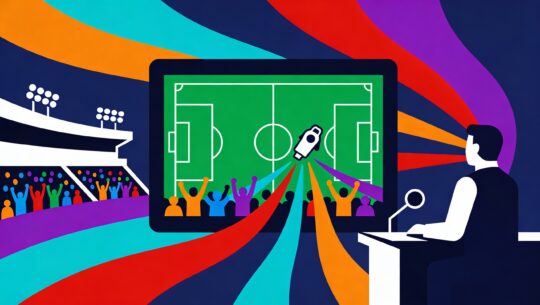
For many people, sport is ninety minutes of emotion—joy, anger, pride, disappointment. For disabled people, it can be all of that and something deeper: a gateway to health, dignity, and social belonging in a world that too often pushes them to the margins. For me, sport has never been just a match; it has always been a social classroom that teaches values, behavior, identity, and even citizenship. The problem is that this classroom can educate or miseducate. And in our time, the strongest “teacher” in this classroom is not the coach or the club—it is the sports media.
This is why I wrote about the role of sports media in spreading sports culture among disabled people, not among fans in general. For years, I have watched how disability sport appears in media: sometimes invisible, sometimes shown only as an emotional anecdote, and only rarely treated as a serious, structured field with rules, systems, and long-term developmental value. As a sports management and physical education researcher, this selective visibility troubled me. I did not want to rely on impressions or personal frustration. I wanted to study this influence scientifically and ask a clear question: How does sports media contribute to sports culture among disabled people, and where does it fall short?
When I speak about “sports culture” in this context, I do not mean chants, fandom rituals, or trending hashtags. I mean the set of knowledge, values, and behaviors that shape how disabled people understand sport and decide whether—and how—to participate in it. Sports culture for disabled people includes awareness of the health and rehabilitation benefits of physical activity, understanding safe training and injury prevention, knowing how nutrition supports performance, recognizing the risks of diseases linked to inactivity, and appreciating values such as cooperation, fair play, and respect. It also includes something more subtle but equally important: the sense that one belongs in sport, that one has the right to be there, and that society recognizes that right.
When this culture is weak, the consequences are tangible. Many disabled people avoid sport out of fear of injury or simple ignorance of its benefits. Families hesitate to encourage participation because they lack accurate information. Clubs and institutions struggle to expand their disability programs because the base of participants remains narrow. In the end, we collectively fail to achieve one of the central goals of sport development: widening the base of safe, meaningful participation. This is not just a technical failure; it is a missed human opportunity.
In the study that inspired this article, the focus was not on abstract theory but on the concrete perceptions of people who work directly with disabled athletes—coaches and administrators in disability sport clubs. The research used a descriptive survey methodology, with a main sample of more than two hundred participants and an exploratory sample used to test the scientific soundness of the questionnaire. The tool went through validity checks, internal consistency analysis, and reliability tests, reflecting a deliberate attempt to move from opinion to evidence.
What emerged from this work was a pattern of strong recognition and strong criticism at the same time. On one side, respondents acknowledged that sports media has an important role in shaping sports culture for disabled people. They highlighted media’s contribution to building accepted social values, encouraging disabled people to join sports institutions, and showing the importance of physical activity for health and rehabilitation. They saw value in media coverage of disability sport championships, the presentation of disabled athletes as role models, and the use of engaging formats to explain the technical aspects of disability sport. When media plays these roles, it does not simply entertain; it informs, motivates, and normalizes the presence of disabled people in the sporting sphere.
On the other side, the same respondents identified serious and persistent challenges. They pointed to the scarcity of research and evaluation about media’s role in disability sport, especially compared with other countries. They described the absence of an integrated media plan dedicated to disability sport, the lack of a clear strategic vision guiding coverage, and the weak application of scientific criteria in how disability sport stories are selected and presented. They also criticized the limited number of educational programs directed specifically at disabled people, as well as the lack of a strong ethical and educational commitment in much of the sports media content.
For me, this mixed picture is not surprising. Media is a powerful but uneven actor. Some programs and journalists invest effort in understanding disability sport—its classifications, rules, health dimensions, and social significance. Others reduce it to a filler segment or a “special story” detached from the everyday rhythm of sport. The study’s results confirm that we are not dealing with a system that is completely absent, but with one that is present without strategy, influential without enough responsibility.
This raises a demanding question for the sports media industry: What identity will it choose in relation to disabled people and their sport? If media accepts that it does shape sports culture, then neutrality is an illusion. Every choice—what to show, how to frame it, which language to use, which guests to invite—either strengthens or weakens the culture of inclusion. Presenting disability sport as an exceptional spectacle emphasizes difference more than normality. Presenting it regularly, with the same seriousness given to other sports, helps disabled people and the public see disability sport as an integral part of the sporting system.
Cultural responsibility in this area is not an abstract slogan. It has very concrete dimensions. It means explaining the rules and classifications of disability sport clearly, so that both participants and viewers understand that the competition is fair and organized. It means highlighting the health benefits of participation and the risks of long-term inactivity, especially when disability can already pose health challenges. It means providing credible information about safe practice, injury prevention, and rehabilitation. It means showing positive role models without turning them into unrealistic superheroes, and respecting the dignity of those whose achievements may be modest but personally transformative.
It also means resisting the temptation of provocation. In some corners of sports media, attention is built through anger, insult, and polarization. When this pattern is mapped onto disability, the harm multiplies. Instead of building a culture of respect and understanding, media can reinforce stereotypes of weakness, dependence, or “inspirational otherness.” A responsible media identity would reject this path—not only for ethical reasons, but also because it undermines long-term trust. Audiences may enjoy controversies, but they remember who treated people fairly.
The benefits of a stronger sports culture for disabled people extend far beyond the individuals directly involved. Families gain clearer guidance and confidence in supporting their disabled members in sport. Clubs and institutions find it easier to recruit, retain, and develop participants, which justifies investment in facilities and staff. Health systems benefit when more disabled people engage in structured physical activity, reducing some of the burdens associated with inactivity. Media outlets that commit to credible, respectful coverage build long-term loyalty and a reputation for professionalism. Society as a whole gains when more of its members—regardless of ability—are visible, active, and recognized in the public sphere.
I did not write this research from a position of hostility toward sports media. Quite the opposite. I wrote it because I have seen how powerful media can be when it chooses to inform rather than distract, to build rather than merely react. Sports media helped create national heroes, shape sporting memories, and connect entire societies around shared events. The question now is whether it will extend that connective power fully to disabled people, not as a seasonal gesture, but as a sustained commitment.
In the end, I believe that disability sport is one of the clearest tests of our sincerity when we claim that “sport is for all.” It is easy to celebrate this phrase in slogans. It is harder to build the culture, the systems, and the media narratives that make it true. Sports media cannot solve every structural problem in disability sport, but it can do something essential: it can show, day after day, that disabled people are not outside the story of sport—they are part of its present and its future.