



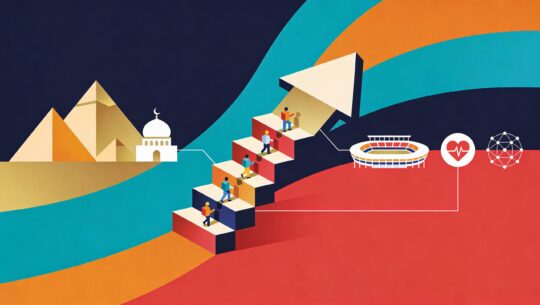
Arab sport has never lacked passion. It has never lacked talent. What it has often lacked is an integrated, long-term development vision that connects participation, health, elite performance, governance, investment, and culture into one coherent system. That is why I prepared this work: a “future vision” for Arab sports development—presented not as wishes, but as a roadmap shaped by indicators, comparisons, and realistic questions about where we are and where we can go.
I am writing this article in my own voice for my personal blog because this project was not simply a collection of slides for a lecture. It reflects years of observation: watching how sports institutions struggle with fragmented planning, how talented athletes sometimes lack pathways, and how opportunities are lost when sport is treated as “events” instead of a national development sector. This vision is my attempt to put Arab sport inside its proper global context, and then to translate that context into actionable priorities for decision-makers, institutions, and communities.
The presentation begins with a simple but powerful statement: sports is a global language. That is not poetry—it is policy. When sport becomes a language, it becomes diplomacy, tourism, health promotion, youth development, and economic value. It becomes one of the few arenas where nations can compete peacefully and be recognized globally.
One reason a future vision is needed is that global sport is increasingly data-driven and industry-driven. The material includes a broad view of the sport industry itself (sports goods, sports tourism, fitness training, sports retailing, amateur recreation, professional sports, and sports medicine), emphasizing that sport is an ecosystem of markets—not only competitions. When policymakers and institutions recognize this, they stop thinking of sport as an expense and start seeing it as a development sector.
Another reason is performance benchmarking. The presentation shows Olympic medal counts and rankings for Arab countries across the Summer Olympics (1896–2020), highlighting that Arab nations have a presence but still face a gap compared with global leaders. A future vision is, in part, a method for closing that gap through systems—not isolated efforts.
This work came from a mixture of pride and frustration.
Pride—because Arab sport has real achievements and real stories of excellence. But frustration—because I have repeatedly seen structural weaknesses that prevent sustainable progress: weak governance, inconsistent talent identification pathways, limited sports science integration, poor investment mechanisms, and the absence of unified national strategies connecting grassroots to elite outcomes.
While building this presentation, I deliberately combined three lenses:
Performance lens: what do results (medals, rankings, participation indicators) tell us?
Industry lens: how big is the economic footprint of sport, and what opportunities exist in events, tourism, goods, and services?
Health and society lens: what do obesity/overweight indicators and physical activity patterns imply about public health—and how can sport become part of the solution?
This mix was not accidental. A real sports development vision cannot be only about winning medals. It must also serve people’s wellbeing, national productivity, and social stability.
The presentation links sport development to economic logic through examples of sports sector impact. For instance, it includes a case showing sport’s economic contribution in the West of England, presenting components such as gross value added, employment impacts, and health-related savings and productivity benefits. The specific country example is not the core message—the core message is that sport can be measured like an economy, and it can be planned like an economy.
It also highlights the business case for hosting major events by presenting “global sporting events in numbers,” with attendance figures and examples of economic contributions and tourism impacts linked to events (e.g., FIFA World Cup and other major tournaments). This matters for Arab countries because event-hosting has grown rapidly in the region, but event-hosting without legacy planning can become a short-term showcase rather than a long-term development engine.
The presentation also touches the reality of health challenges by including comparisons related to obesity and overweight rates in different Arab countries (separate visuals for males and females). This is a serious point: if communities face rising inactivity and obesity, sport development must include mass participation, school sport, community programs, and “active nation” strategies—not only elite teams.
Even though this work is presented as slides, its direction is clear. A future vision for Arab sports development must integrate several pillars:
Participation and physical activity: because the base of the pyramid builds the top, and because sport is a public health instrument.
Talent pathways and elite performance: because global competition is increasingly professionalized and scientifically supported.
Sports industry and investment: because sustainable development requires diversified revenue sources, professional event management, and investable governance.
Sports tourism and major events: because the region has strong potential, but needs legacy planning to turn events into long-term benefits.
Governance and organizational readiness: because institutions must be agile, well-structured, and transparent to execute a vision rather than only announce it.
One slide even echoes the concept of organizational agility—asking whether we are “all on the same boat,” a reminder that strategy requires alignment and adaptability, not only ambition.
This roadmap is not meant for one group only. It is meant for an entire ecosystem:
Government decision-makers and ministries: because national frameworks and funding models shape participation, facilities, and elite programs.
Sports federations and clubs: because implementation happens inside institutions, not inside speeches.
Investors and sponsors: because sport becomes more investable when it is planned as a sector with measurable outcomes.
Youth and families: because the true success of sport development is seen in healthier lifestyles, safer communities, and meaningful opportunities.
Academics and sports science professionals: because evidence-based planning is essential for performance, health, and policy evaluation.
I hope it changes the conversation in Arab sport from “we need more championships” to “we need better systems.” Championships are outcomes. Systems are causes.
I also hope it encourages institutions to coordinate rather than compete internally. When ministries, federations, clubs, schools, and private sector actors pull in different directions, development becomes expensive and slow. When they align, progress accelerates.
Finally, I hope it helps young people feel that sport is not a dead-end dream. With the right development model—clear pathways, education support, sports science integration, and transparent governance—sport becomes a credible life path, a health path, and a community-building path.
This future vision was built on one belief: Arab sport can lead globally, but leadership requires strategy. It requires measuring where we stand, learning from global models, investing wisely, and remembering that sport’s deepest value is human—health, discipline, belonging, and hope.
Sport is a global language, yes. My goal is for Arab countries to speak that language fluently—not only in moments of celebration, but through sustained development that lasts for generations.