


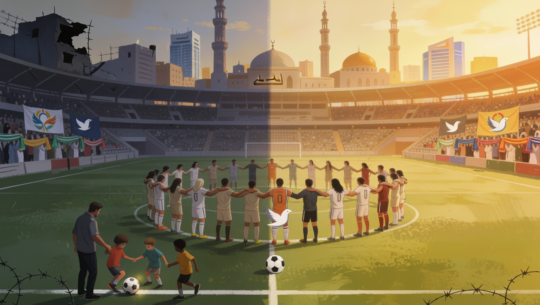
In the Arab region, conflict is not only a headline—it is a lived reality that shapes families, economies, identities, and futures. For a long time, many people treated sport as entertainment separated from politics and society. But I have never believed that sport is neutral. Sport is a social institution: it can intensify division, or it can soften it; it can become fuel for hatred, or a language for coexistence. That is why I wrote this paper on the role of sport in achieving peace in the Arab region under the pressures of internal and regional conflicts.
This blog article is written in my own voice, because the topic is deeply human for me. I did not approach it only as a sports management researcher. I approached it as someone who has watched how conflict reshapes social trust, and who also knows—through sport—that people can share a moment of respect even when their politics and histories are painful. The paper is my attempt to discuss sport as a peace instrument with academic seriousness and practical realism, not as a romantic idea.
Sport is a structured space where rules exist, fairness is expected, and the “other” is recognized as a legitimate competitor, not an enemy. That structure matters. In societies under tension, daily life often loses shared rules—people withdraw into groups, narratives harden, and suspicion becomes normal. Sport, at its best, can rebuild a small piece of shared life: a stadium, a field, a club, a league, a youth program—spaces where people meet under agreed rules and shared excitement.
The paper’s theme is clear from its title and references: it links sport to peace-building within a region affected by internal and regional conflicts, and it draws on concepts related to conflict and conflict management inside sport organizations and societies. The study also references international frameworks and organizations such as UNESCO in its wider discussion, reflecting that sport-for-peace is not only a local idea, but part of global thinking on education, culture, and human development.
What made this paper difficult is that writing about “sport and peace” can easily fall into slogans. Everyone wants peace. Everyone says sport “brings people together.” But the real question is: how, under what conditions, and with what risks?
While working on this topic, I had to be honest about two realities:
Sport can unite, but it can also divide. A match can be a festival of respect, or it can become a stage for political anger and identity conflict.
Peace-building is not created by a single event. It is built through systems: youth development programs, education, fair governance, anti-discrimination measures, and consistent messages across institutions.
The paper is grounded in conflict-related literature and organizational conflict thinking (the references include works addressing conflict in sport organizations, models of conflict, and distorted social change), because peace is not achieved by “good intentions.” It is achieved by understanding conflict drivers and designing interventions that reduce those drivers.
Even without reproducing the original text, the paper’s structure and references signal a central argument: sport has potential roles in reducing conflict and supporting peace in the Arab region—if it is managed consciously and institutionally.
The discussion is linked to internal and regional conflict pressures, and this context matters: peace work in stable environments is one thing; peace work in conflict environments requires additional sensitivity, safeguards, and long-term planning.
The paper’s reference list includes academic sources in sport management and conflict, reflecting that this is treated as a research topic, not a media opinion. This academic framing is important because it protects the subject from being reduced to emotional storytelling. Sport-for-peace must be designed and evaluated like any serious program: with objectives, mechanisms, and measurable outcomes.
From a sports management perspective, sport contributes to peace when it creates repeated “micro-experiences” of coexistence that accumulate over time. Peace is not only the absence of war; it is the presence of relationships, trust, and fair opportunities.
Sport can support peace through mechanisms such as:
Youth programs that mix participants from different communities under rules of fairness and teamwork.
Competitions that emphasize respect, inclusion, and shared celebration, not humiliation and hatred.
Clubs that operate as community institutions—offering safe spaces, mentorship, and identity alternatives to violence.
Regional sports exchanges that humanize “the other” and reduce the psychological distance created by conflict narratives.
This logic aligns with the paper’s overall aim: studying sport within the context of conflict and peace, using conflict frameworks and institutional perspectives rather than treating sport as separate from social reality.
When sport is discussed as a peace tool, the audience is wider than coaches and athletes.
Youth and families: because youth are often the most vulnerable to conflict narratives, and sport can offer identity, belonging, and discipline in a non-violent structure.
Schools and universities: because sport programs inside education can become structured peace education through lived practice, not only classroom theory.
Sports federations and clubs: because governance and event management determine whether sport becomes inclusive or divisive.
Media: because the framing of sport events can either promote dignity or amplify hatred, especially in politically sensitive contexts.
Policy-makers and civil society organizations: because peace-building requires partnership—sport alone cannot carry the burden, but it can be an effective channel within a broader social strategy.
Even the sports economy is affected. In regions of tension, investments hesitate, events are threatened, and sports development slows. Peace-building—when approached seriously—creates a safer environment for long-term sports industry growth, employment, tourism, and regional cooperation.
I hope this paper changes the way decision-makers talk about sport. Instead of saying “sport brings peace” as a general belief, I want institutions to ask:
What programs will we design to reduce conflict risk?
What values will we train coaches and administrators to uphold?
How will we protect sport spaces from becoming platforms for hate?
How will we evaluate whether a program truly increases social trust?
Because if sport is left unmanaged, it reflects society’s conflict. But if sport is managed wisely, it can model a different way of living together—one where competition exists without dehumanization, and where identity exists without hatred.
I wrote this paper because I believe peace in the Arab region cannot be built only through politics. It must also be built through society—through youth, education, culture, and shared institutions. Sport is one of the strongest shared institutions we have, precisely because it speaks to people beyond ideology and beyond language.
When a stadium becomes a bridge instead of a battlefield, that is not an accident. It is leadership, governance, education, and ethical responsibility. And that is the real message I wanted this research to carry.
