


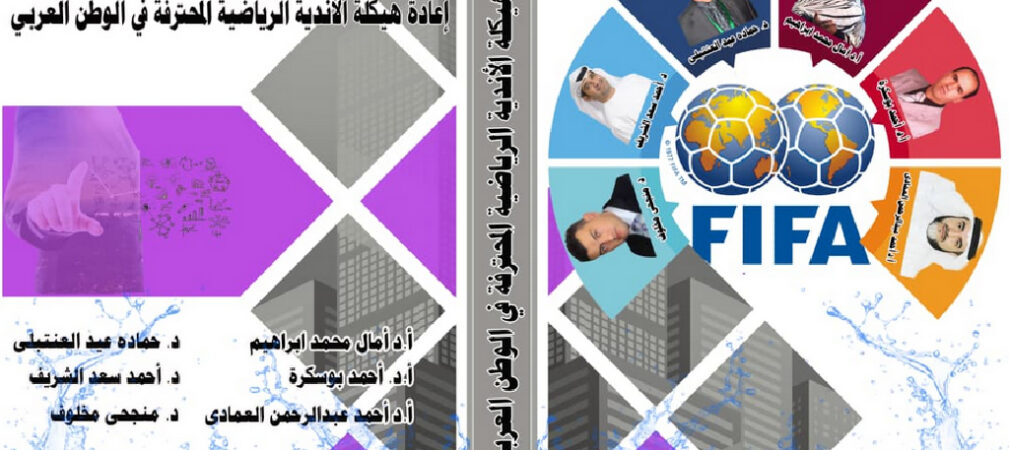
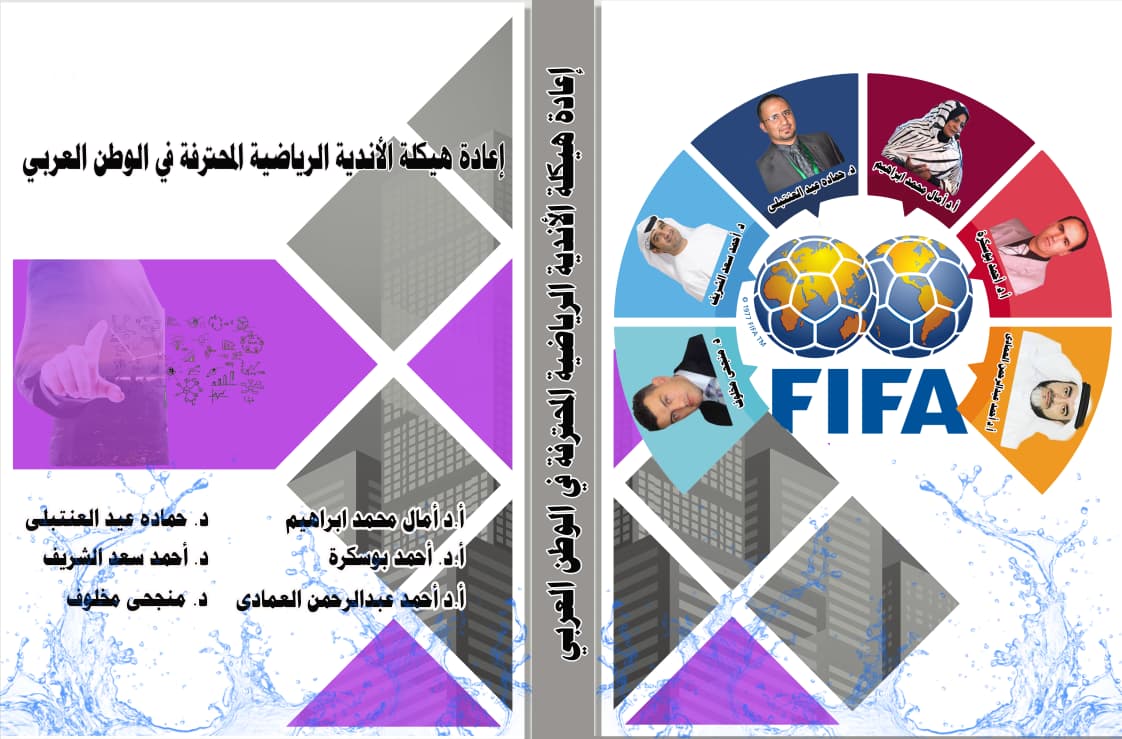
I wrote Restructuring Professional Sports Clubs in the Arab World because the Arab sports club—especially in football—has been living for years inside a difficult equation: rising expectations, limited resources, and administrative structures that were not built for the era of professionalism. This book is my attempt (with a group of respected colleagues) to open a serious, structured conversation about how our clubs can move from recurring financial and managerial crises toward sustainable professional models aligned with international requirements and modern sports economics.
In recent years, the world has entered a new era shaped by technological transformation and administrative challenges, where excellence in performance has become a decisive factor for progress in every field. Sport is not an exception—if anything, it is one of the most visible areas where the public can instantly feel the difference between good management and weak management.
I kept returning to a simple but heavy question: if professionalism has become the global language of sport, why do so many of our clubs still operate with structures that belong to a different time? The introduction of the book states clearly that modern management requires the ability to adapt to continuous change and to adopt flexible organizational patterns that suit the nature of operations and roles. That sentence summarizes the entire motivation: when clubs do not adapt, they do not merely “stay behind”—they become vulnerable to instability.
In the Arab context, the problem is not talent. Arab sport has talent, passion, and loyal communities. The problem is that institutions often carry financial and administrative burdens that affect the entire sports movement. And when the club is unstable, everything around it becomes unstable: the player pathway, coaching development, youth projects, and even community trust.
The emergence of professionalism had a positive organizational, administrative, and popular impact on football, and FIFA’s decisions supporting restructuring became a major stimulus for going deeper into the topic of restructuring professional clubs in the Arab world. For me, this was not about “following FIFA” as an authority; it was about recognizing that global football governance was pushing the game toward minimum standards of professionalism, transparency, safety, and integrity—standards that ultimately protect the club, the league, and the sport itself.
The introduction explains the book’s core aim: to be a guide that can be referred to when an Arab sports club wishes to undertake a restructuring process—especially given the financial and administrative problems that have affected Arab sport broadly. In other words, it is meant to be usable, not just readable.
This book was prepared by a team that includes Prof. Dr. Amal Mohamed Ibrahim, Prof. Dr. Ahmed Bouskara, Prof. Dr. Ahmed Al-Emadi, Dr. Ahmed Saad El-Sherif, Dr. Menjahy Makhlouf, and myself, Dr. Hamada Eid El-Antably. Working in a group was not simply an academic choice; it reflected the nature of the challenge itself. Restructuring is never an individual act. It requires multiple perspectives: administrative, economic, legal, and technical.
Personally, my role in this project came from years of observing how clubs struggle when professionalism becomes a “label” rather than a full system. Many clubs announce professional ambitions, yet remain stuck in the same funding patterns, the same governance weaknesses, and the same blurred line between volunteer-style management and professional accountability. This book was written to help replace improvisation with methodology.
The dedication in the book is directed to our professors, colleagues, leaders and thinkers in the sports field, and every student of knowledge in sport. That dedication is not ceremonial—because the future of sports institutions depends on people who can learn, rethink, and implement reform with responsibility.
We designed the book in six chapters, presented gradually through the lens of FIFA’s 2007 direction, and connected to the realities of the Arab world. The structure reflects a deliberate logic: start with the concept of professionalism, then move to the conceptual framework of restructuring, then to the economic model, then to licensing and club identity, then to commercial engines, and finally to risk protection through insurance.
Here is the pathway in a clear form:
Chapter 1: Professionalism (concept and roots).
The book starts by grounding professionalism: its concept, origins, and its relationship with the Olympic Games. This matters because misunderstanding professionalism leads to superficial reform—while real reform starts with a clear definition.
Chapter 2: Restructuring and its drivers.
We discuss the conceptual framework for restructuring and its justifications in light of FIFA’s decision, including reasons behind restructuring and the relationship between restructuring and privatization. The chapter also introduces the concept, goals, types, and international experiences of privatization.
Chapter 3: The economic structure of sports clubs.
This chapter treats the professional club as a for-profit institution, discusses club economics, investment, and sports financing and its forms. Without an economic model, professionalism becomes financially impossible.
Chapter 4: The professional club under FIFA 2007.
We address the concept and structure of the professional club as described by FIFA 2007, including club licensing standards, their objectives and items, and the ownership structure and management mechanism of the club. This is the governance spine of the entire project.
Chapter 5: Sponsorship, marketing, and investment.
We cover the evolution of commercial sponsorship in sports events, its principles, and the legal analysis of sponsorship contracts, then move into marketing and investment inside clubs. This chapter exists because clubs cannot depend forever on unstable funding; they need structured revenue-building capabilities.
Chapter 6: Insurance in sport.
We conclude with insurance in the sports field—especially insurance for players against injuries and accidents—along with technical foundations, insurance contracts, conditions, and types of insurance policies. This is often neglected in reform conversations, yet it is essential for protecting human capital and stabilizing operations.
This work was written for decision-makers in clubs, federations, ministries, and the wider sports ecosystem, and also for researchers and students who want an academically grounded reference. Its real audience includes:
Club boards and executive leaders: to help them translate professionalism into structures, policies, and accountability frameworks consistent with global requirements.
Financial and legal teams: because restructuring is inseparable from financing models, contracts, and regulatory compliance.
Sports investors and sponsors: because governance clarity, transparency, and a credible business model determine whether a club is investable.
Players, coaches, and youth sectors: because sustainable management protects careers, develops pathways, and reduces the chaos created by unstable budgets and weak administration.
The book’s impact—if applied seriously—can be practical: clearer ownership and management structures, more reliable revenue planning through sponsorship and marketing, stronger alignment with licensing standards, and better protection against risks through insurance. At a broader level, the book argues for an Arab professional club system that is compatible with international organizing bodies and supports the investment-oriented view of sport that defines the current era.
In the introduction, we say openly that we do not claim perfection; we only claim honest effort, and that this work should be a starting point toward building a professional club system aligned with FIFA decisions and supportive of investment-oriented sports thinking. That is exactly how I see it: restructuring is not a single document, and it is not a one-time event. It is a continuous commitment to governance, financial discipline, and institutional learning.
And if there is one hope behind this book, it is that the Arab sports club can become what its community already believes it is: not only a symbol of identity and passion, but a stable institution capable of excellence—on the field and beyond it.
