



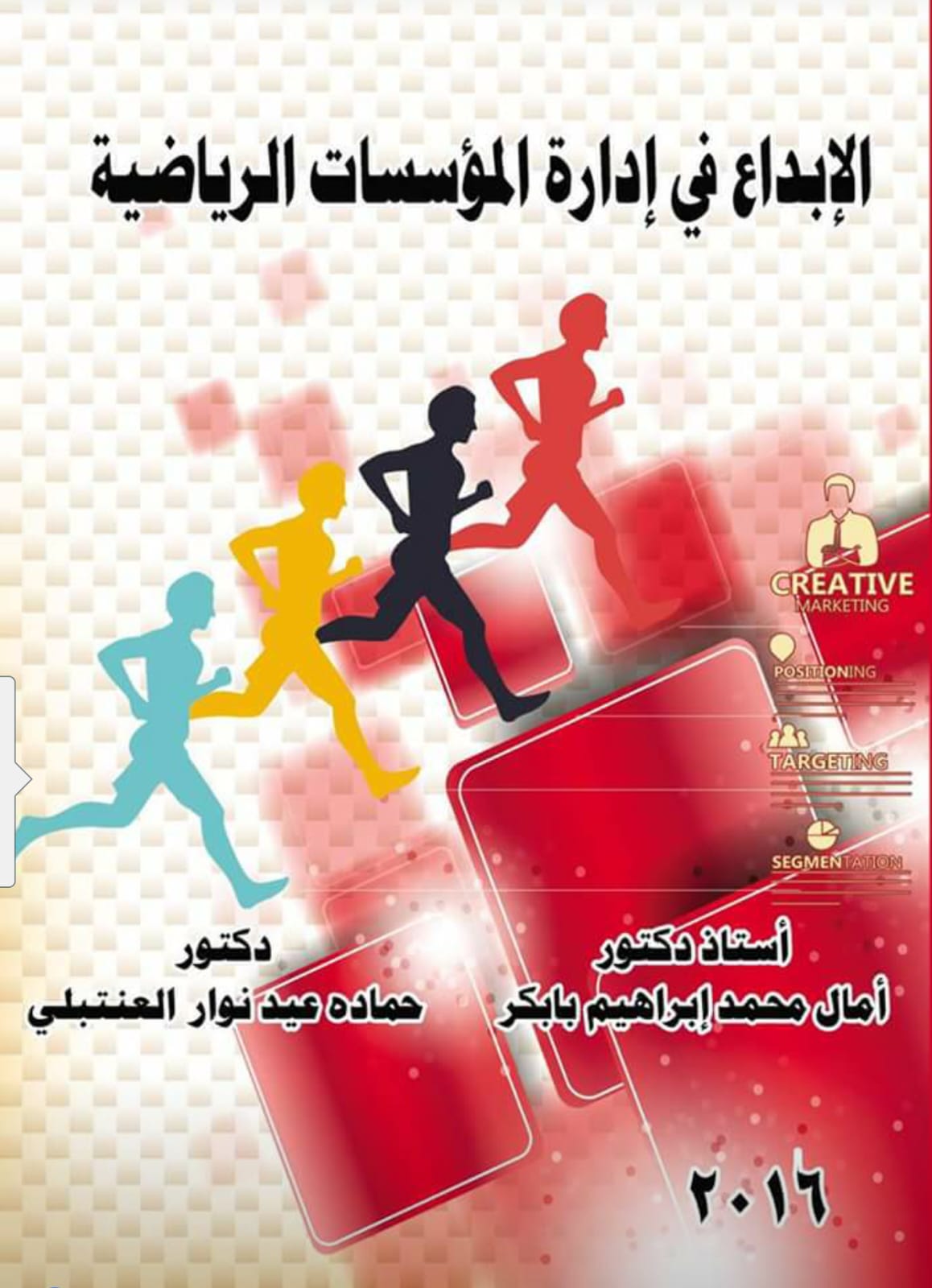
This book was written because I became convinced—through years of academic work and real contact with the sports field—that many of our sports institutions will not survive the pace of modern change unless they learn how to manage creativity systematically, not accidentally. Creativity in the Management of Sports Institutions is my attempt (together with Prof. Dr. Amal Mohamed Ibrahim Babiker) to offer leaders, practitioners, and students a clear framework that turns “creative thinking” into institutional practice and measurable development.
We live in an era of rapid, continuous change—information travels instantly, technology reshapes expectations, and organizations are compared globally in real time. In the book’s introduction, we speak directly about how sports institutions—clubs, federations, Olympic committees, and governmental bodies—face repeated challenges and obstacles that can block their development if they rely on routine and imitation. I have seen this pattern many times: passionate people working hard, but within systems that do not reward initiative, do not invest in new approaches, and sometimes even punish experimentation.
What pushed me to write was not only the “presence of problems,” but the repeated evidence that these problems were not technical—they were managerial and cultural. Many studies (as we noted) indicated shortcomings in the management of sports institutions and a lack of administrative creativity, initiative, and the willingness to adopt practices that raise effectiveness and support the advancement of Arab sport. At that point, the question became personal for me: if management is the engine, why do we keep treating creativity like an optional decoration?
This work is built on a simple belief: creativity is not a gift reserved for a few; it is a skill and a discipline that can be learned, practiced, and developed—similar to any other competence. That principle matters deeply in sport, because sport combines human passion with organizational complexity. Without creative management, the institution becomes slow while the world becomes fast.
In the early chapters, we clarify creativity as a concept and address the long-standing confusion between “creativity” and “innovation/innovation timing” in Arabic usage, then present creativity as a process that produces something new and valuable—often by building new relationships among previously unconnected elements. We also explain why sports institutions need creativity: changing technology, shifting audience preferences, performance gaps, and rising competition all create pressure that routine methods cannot absorb. In other words, creativity becomes a survival tool, not a luxury.
Writing this book required me to slow down and become both researcher and listener. The research side was intense: definitions, theories, models, and the “process view” of creativity—including the stages of preparation, incubation, illumination, and verification—had to be treated carefully and academically. At the same time, I wanted the book to speak to practitioners, not only to scholars—because the sports manager in a club office needs usable methods, not just terminology.
One of the most challenging parts was balancing idealism with realism. It is easy to write slogans about creativity; it is much harder to describe the obstacles that kill it inside institutions: fear of change, rigid structures, unclear goals, and leadership patterns that block participation. We deliberately addressed these barriers because denial is expensive—especially in organizations where budgets are tight and public expectations are high.
I also carried a personal conviction while writing: the sports institution is not only a service provider; it can be a national asset, a community builder, and even a contributor to the economy. So I felt responsible to write something that respects the academic standard yet remains humane—because behind every “institution” there are people trying to do meaningful work.
In the introduction, we explain that we organized the book into seven chapters that move step-by-step: from defining creativity, to creative thinking and its mechanisms, to administrative creativity, then institutional creativity and how to build a supportive climate, then technological creativity, and finally the economic/legal dimensions around marketing creative people and sports sponsorship contracts.
More specifically, the book covers themes such as:
The concept of creativity and the need for it in modern sports institutions, including characteristics, encouraging factors, and principles that help creative ideas grow instead of being “killed early”.
Creative thinking as a practical skill (including divergent thinking), and why traditional measurement tools often fail to capture creative capability.
Administrative creativity in sports institutions, including definitions and why it becomes essential under information revolutions, technological acceleration, and intensified competition among sports organizations.
Building the creative sports institution: strategies, supportive culture, and how organizational development and technology can enable creativity rather than restrict it.
Technological creativity in sport, because we are living in what the book calls the era of technology and digital wealth—an era that forces institutions to keep pace.
Marketing creative individuals and sponsorship in the context of sports contracts, including clarifying the confusion between sponsorship, marketing, investment, and advertising, and addressing legal protection elements for sports events.
This structure was intentional. I wanted the reader to feel that creativity is not a single chapter; it is a chain. If any link breaks—thinking, leadership, culture, technology, or funding—the institution struggles.
When we addressed “the dear reader” in the introduction, we meant it broadly: anyone in sports institutions, regardless of position, whether the organization is small or large. In practice, the book serves several groups:
Sports leaders and administrators: It helps leaders move from managing by routine to managing through creative problem-solving, participation, and strategic renewal—especially when resources are limited and expectations are growing.
Coaches, technical staff, and employees: A creative climate benefits everyone. When staff are given autonomy, encouragement, and a safe space to try new approaches, institutions unlock hidden capabilities and raise morale.
Students and researchers in sports management: The book offers an academic grounding—definitions, models, stages, and classifications—while connecting these ideas to the realities of sports institutions in our region.
The deeper impact, in my view, is cultural. A sports institution that learns how to encourage creativity can become more adaptive, more resilient, and more capable of serving its community with improved services and smarter use of resources. And when sport improves institutionally, athletes and audiences feel the difference—because quality management eventually appears on the field, in events, and in public trust.
The book ends the way it began: with a sincere invitation for feedback and a hope that this effort contributes to improving administrative practice and enriching the sports library. That is still my position today. I believe that creative management is one of the most practical paths to reform—not by replacing identity or tradition, but by refusing stagnation.
The message is not “be creative” as a motivational phrase. The message is: create conditions where creativity can exist—clear objectives, supportive leadership, participation in decision-making, openness to technology, and the courage to treat change as normal rather than threatening. If sports institutions adopt that mindset, they do not only keep up with the world; they can help shape it.
